
Hotel security systems: the UK manager's procurement guide


A complete hotel security system combines CCTV, electronic access control, intruder alarms, fire detection, visitor and vehicle management, and a hardened property management system (PMS) network, all linked to an Alarm Receiving Centre (ARC). That is the minimum. Anything less leaves exploitable gaps, whether a tailgated service entrance or an unpatched PMS that hands attackers guest card data.
Your immediate next actions:
Commission a risk-led site survey from a supplier who will produce a written report, not just a verbal walk-around.
Request a proposal that covers design, staged installation, commissioning documentation, and a maintenance SLA.
Require evidence of NSI, SSAIB, or BSI accreditations before shortlisting any supplier.
Check that the proposal addresses both physical controls and PMS network hardening, as NIST SP 1800-27 makes clear these are inseparable.
Contact Threesixtyfireandsecurity to request a site survey and a sample commissioning report before you finalise your brief.
Pro Tip: Brief your supplier with a written scope before the site survey. Even a one-page list of zones, shift patterns, and known incidents will produce a sharper proposal and a more accurate cost model.
Table of Contents
How do AI analytics and monitoring models improve detection?
Securing the digital layer: PMS hardening and network controls
How Threesixtyfireandsecurity designs and delivers integrated hotel security
What hotels consistently get wrong, and what managers regret later
Threesixtyfireandsecurity: integrated hotel security, designed and maintained
What does a hotel security system actually need to cover?
Security for hotels is not a product. It is people, policy, and technology working together across four concentric layers: the external perimeter, guest-facing areas, back-of-house operations, and IT systems. Weaken any one layer and the others compensate poorly.
The physical layers handle life-safety and crime prevention. Fire detection and suppression protect lives and satisfy UK fire safety obligations under the Regulatory Reform (Fire Safety) Order 2005. CCTV and access control deter and detect theft, assault, and unauthorised entry. The digital layer, principally the PMS and the networks it sits on, holds guest names, payment card references, and room-assignment data. That combination makes it a high-value target.
Regulatory requirements in the UK hospitality sector typically mandate maintaining specific security standards, protecting guest privacy, and implementing verified emergency procedures. The ICO’s CCTV guidance adds data-protection obligations on top: retention limits, access logs, and signage. A system that satisfies the physical side but ignores the digital side will fail an audit and, more importantly, will fail a guest.
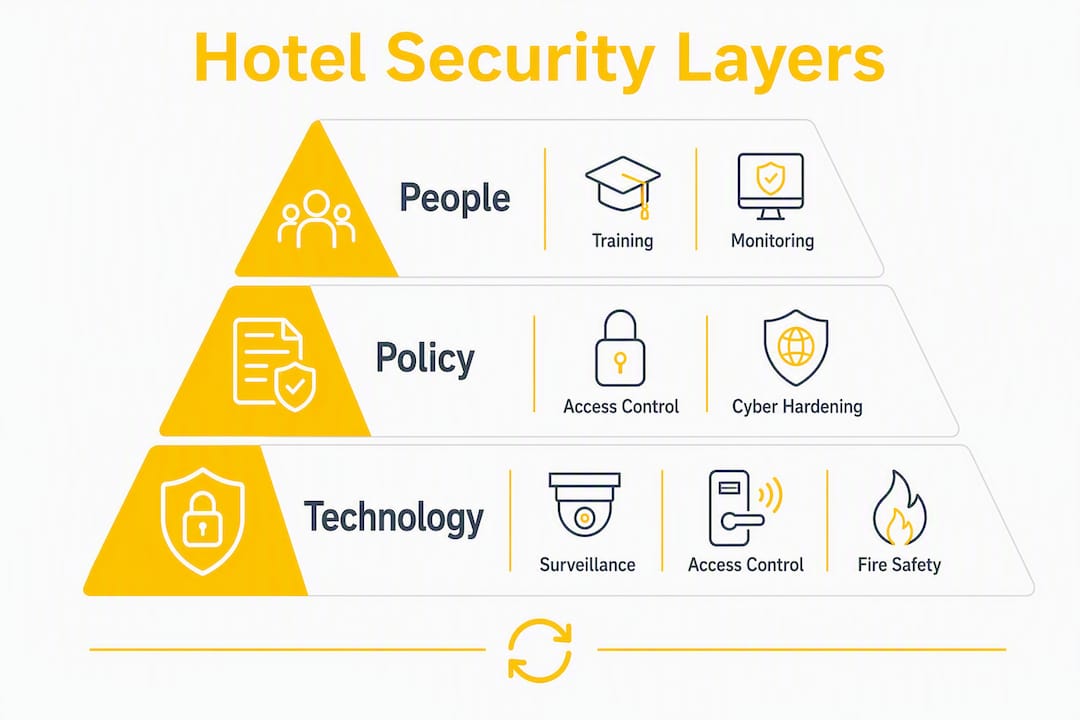
Core components every hotel security system should specify
CCTV and surveillance
Fixed cameras cover static zones such as reception, lifts, and corridors. PTZ (pan-tilt-zoom) cameras suit large open areas like car parks and lobbies where an operator needs to track movement. Thermal cameras add value at perimeter boundaries in low-light conditions, particularly for larger resorts.
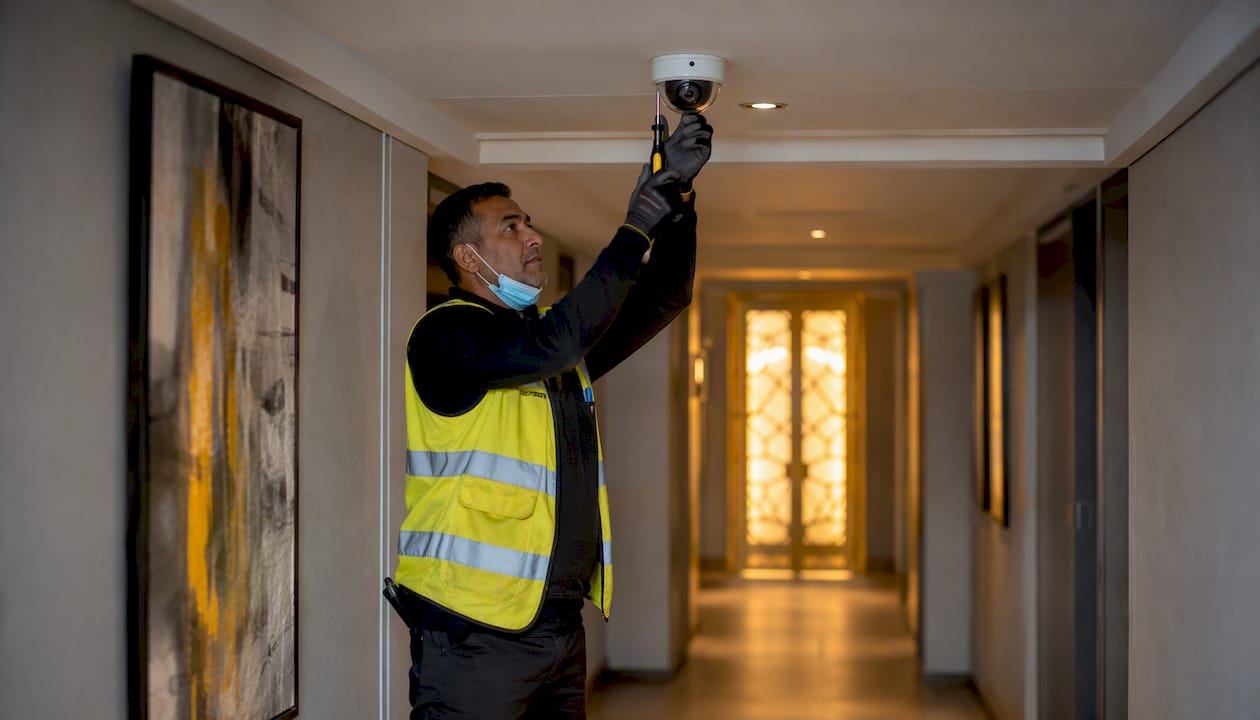
PoE (Power over Ethernet) cameras simplify cabling, support central battery backup, and reduce maintenance compared with separate power runs, making them the practical default for most hotel installations. Storage can sit on a local NVR, in the cloud, or in a hybrid arrangement; multi-property groups typically benefit from cloud or hybrid to allow centralised review.
Privacy placement rules are non-negotiable. CCTV is permitted in public and shared areas; cameras in guest rooms or bathrooms are illegal and carry severe reputational and legal consequences. Every camera position must be documented, signed, and included in the commissioning pack.
Access control
Electronic locks on guest rooms, service lifts, plant rooms, cash stores, and back-of-house corridors form the backbone of hotel access control systems. Mobile key credentials are increasingly standard in mid-to-upper-tier properties. What matters operationally is granularity: a housekeeper’s credential should not open the server room, and a contractor’s day pass should expire automatically at shift end.

Audit logging is the feature most managers underestimate. When an incident occurs, timestamped door-event records combined with CCTV footage resolve disputes in minutes rather than days.
Intruder alarms and duress
Perimeter sensors, glass-break detectors, and passive infrared devices form the detection layer. Panic buttons for front-desk and lone-working staff are a separate but equally important element, particularly under the Protect Duty (Martyn’s Law) framework progressing through UK legislation. Intruder alarm systems linked to an ARC enable verified alarm reporting, which is the threshold most police forces now require before dispatching a response.
Fire and life-safety
Fire alarm systems must be designed, installed, and commissioned to BS 5839 and must satisfy the Responsible Person’s obligations under UK fire safety law. Interlocks with lifts, door releases, and ventilation systems are standard in larger properties. The commissioning certificate is not optional; insurers and fire authorities will ask for it.
Visitor management and ANPR
Contractor vetting, visitor badges, and a digital sign-in log close a gap that physical locks alone cannot. For properties with car parks, Automatic Number Plate Recognition (ANPR) cameras add vehicle-level access control, support parking enforcement, and create an evidential record for incidents.
Operational hardening
Safes, secure luggage storage, adequate external lighting, and physical barriers such as gates and bollards complete the picture. These are often treated as afterthoughts but appear repeatedly in post-incident reviews as the measure that would have made the difference.
How do AI analytics and monitoring models improve detection?
AI-driven video analytics can do things a human operator watching twelve screens cannot: count people in a zone, flag loitering at a service entrance, detect a left object in a lobby, or read a licence plate in under a second. Integrated fire, life-safety, and surveillance systems allow continuous 24/7 monitoring and faster incident response. The technology is genuinely useful. It is also genuinely over-sold.
False positives are the practical problem. A busy hotel lobby generates constant movement; an analytics rule tuned too broadly will produce so many alerts that staff start ignoring them. Weapon-detection and left-object algorithms perform well in controlled tests and less consistently in real hospitality environments with high footfall, luggage, and variable lighting.
Monitoring models break into three options. A local security room gives the fastest on-site response but requires staffing around the clock. A centralised video management system (VMS) with remote access suits properties where a manager needs to review footage from multiple sites without a dedicated control room. An ARC contract provides professional 24/7 monitoring and verified alarm response without the staffing overhead, and it is the model most UK insurers prefer.
For investigations, the real value of an integrated system shows clearly. Combining access-control logs, PMS check-in records, and CCTV timestamps lets a manager reconstruct an incident in minutes and hand a coherent evidence package to the police.
Pro Tip: Deploy AI analytics selectively. Car parks, service yards, and main entrances justify the investment and the alert-management overhead. Blanket analytics across every camera multiplies false alerts and licence costs without proportionate security gain.
How to evaluate and choose a hotel security supplier
Questions to ask in every tender response
Can you provide a written site survey report, not just a verbal assessment?
Does your design include integration with our PMS and building management system?
Can you supply sample schematics and a commissioning test report from a comparable hotel project?
What is your ARC partner, and how is verified alarm response handled?
What does your maintenance SLA cover, and what are the defined response times?
How do you handle network segmentation for security devices, and do you have a data-protection statement for CCTV and PMS integration?
Can you provide references from hospitality clients of a similar size and type?
Accreditations and trust signals to require
NSI (National Security Inspectorate) or SSAIB (Security Systems and Alarms Inspection Board) approval is the baseline for intruder and CCTV installation. BSI certification is relevant for fire systems. Where guarding is part of the scope, SIA licensing applies. Ask for the certificate number and verify it directly with the issuing body.
Red flags
No documented commissioning pack is a serious warning sign. So is a supplier who cannot produce a maintenance SLA with defined response times, or who pushes back on network segmentation for security devices. A proposal that ignores data-protection obligations for CCTV footage or PMS integration suggests the supplier has not worked in regulated environments before.
Cost and timeline framing
Most hotel security projects follow a CAPEX model for hardware and installation, with OPEX recurring costs for maintenance contracts, ARC monitoring, and analytics licences. A realistic project timeline runs through stages such as site survey, detailed design and procurement, installation depending on property size, commissioning and testing, and handover and staff training, each taking an appropriate time frame based on project complexity. Budget separately for annual preventative maintenance visits and for technology refresh cycles, typically every five to seven years for cameras and access hardware.
Supplier comparison framework
Evaluation dimension | What to look for |
Coverage objectives | Guest areas, back-of-house, external perimeter, car park all addressed in design |
Best for hotel type | Boutique city hotel vs large resort vs multi-site group |
Deployment model | On-site NVR, cloud VMS, or hybrid; ARC-linked or self-monitored |
PMS and BMS integration | Documented API or protocol compatibility; PII minimisation approach |
Service model | Warranty period, SLA response times, remote health monitoring, ARC linkage |
Cost model | CAPEX vs OPEX split; analytics licence costs itemised separately |
Compliance and certifications | NSI, SSAIB, BSI, SIA where applicable; hotel-sector case studies provided |
Pro Tip: Insist on sample test reports from a previous hotel installation before signing. Also negotiate a 30–90 day warranty period specifically for adaptations discovered once the system goes live, such as camera blind spots or access-zone conflicts that only emerge under real operating conditions.
What to expect from survey through commissioning and beyond
Project milestones
A professional installation follows a clear sequence. The site survey produces a written risk assessment and zone map. Detailed design translates that into schematics, a camera schedule, an access-zone matrix, and a fire-zone layout. Procurement follows once the design is signed off. Installation is staged to minimise disruption to live operations. Commissioning involves testing every detector, camera, door reader, and alarm path against the design specification. Handover includes staff training and the full documentation pack.
What the commissioning pack must contain
Document | Purpose |
As-installed schematics | Reference for future maintenance and modifications |
Detector calibration sheets | Evidence of correct sensitivity settings at commissioning |
CCTV camera schedule and coverage maps | Confirms legal placement and zone coverage |
Alarm zone list and ARC notification schedule | Defines response routing and escalation paths |
Software credentials and licence records | Enables future updates and vendor support |
Commissioning test logs | Required by insurers and fire authorities |
Successful hotel security treats systems as a dynamic management process with regular, documented testing of fire and intruder systems for insurance and compliance. That means the commissioning pack is not filed and forgotten; it is the baseline against which every annual test is measured.
Maintenance and SLA essentials
Minimum two preventative maintenance visits per year for fire and intruder systems.
Defined response times: typically four hours for critical faults, next business day for non-critical.
Remote health monitoring for camera and alarm panel status where available.
Software update management included in scope, not charged as extras.
Spare-part provisions for critical components with agreed lead times.
Penalty clauses for missed SLA response times, documented in the contract.
Securing the digital layer: PMS hardening and network controls
The PMS is the most attractive target in a hotel’s IT estate. It holds guest names, payment references, room assignments, and loyalty data, often connected to booking platforms, payment terminals, and door-lock systems simultaneously. NIST SP 1800-27 recommends zero trust architecture, role-based access control, privileged access management, and network segmentation as the core controls.
Key controls to specify:
Network segmentation: Security devices (cameras, door readers, alarm panels) must sit on separate VLANs from the guest Wi-Fi and the PMS. A compromised camera should not be a stepping stone to the booking system.
Role-based access control: Front-desk staff need different PMS permissions from housekeeping supervisors and finance managers. Privileged accounts for IT administrators should require multi-factor authentication.
PII minimisation in key encoding: The NIST reference design demonstrates that the PMS needs to pass only a room number to the physical access control system during key encoding, not the guest’s name or payment data. That single design decision materially reduces PII exposure.
Encryption: Guest data at rest and in transit should be encrypted. This applies to CCTV footage stored on cloud platforms as much as to PMS database backups.
Patch management and change control: Unpatched PMS software and firmware on network-connected cameras are among the most common entry points. Agree a patch cycle with your supplier and document it in the SLA.
Vendor remote access: Any supplier who needs remote access to maintain systems should connect through a controlled, logged gateway, not a standing VPN credential.
ICO alignment: Retention periods for CCTV footage and guest records must be documented and enforced. The ICO’s guidance on CCTV and data protection sets the framework; your policies should reference it explicitly.
Policies, training, and building a security-aware culture
Technology without trained people is a liability. Industry guidance consistently recommends regular role-based training and a culture of awareness to identify and report suspicious activities. The system logs the event; a trained member of staff decides what to do about it.
Essential policies every hotel should have in writing:
CCTV use and disclosure policy (who can access footage, under what circumstances, and for how long it is retained).
Data-retention policy covering both CCTV and guest PMS records.
Visitor and contractor vetting procedure, including ID checks and temporary credential management.
Emergency response procedures that reference the specific alarm zones, evacuation routes, and ARC contact protocols in your installed system.
Training programme elements:
Induction security training for all new staff, covering their specific role’s responsibilities.
Role-based drills: fire evacuation, active-threat response, and lone-worker check-in procedures.
Front-desk training on handling suspicious enquiries, tailgating, and the correct procedure for requesting police attendance.
Periodic refreshers, at minimum annually, with attendance records kept.
Incident logging and after-action reviews close the improvement loop. Every false alarm, every access-control anomaly, and every CCTV-assisted investigation should be recorded. Patterns in that log will tell you more about your actual risk profile than any theoretical assessment.
Pro Tip: Run at least one full-scale evacuation drill and one system-failure drill each year. Document the outcomes in your security management plan. Insurers and fire authorities may ask to see them, and the exercise almost always surfaces a procedural gap that no amount of desk-based planning would have caught.
How Threesixtyfireandsecurity designs and delivers integrated hotel security
Threesixtyfireandsecurity’s methodology starts with a risk assessment and written site survey, producing a zone-by-zone threat map before a single product is specified. The design phase translates that into a bespoke system architecture covering fire, intruder, access control, and CCTV, with explicit documentation of how each subsystem integrates with the hotel’s PMS without unnecessary PII transfer. Installation is staged to protect live operations, followed by full commissioning against the design specification and a handover pack that includes as-installed schematics, test logs, and staff training.
ARC linkage is handled through established monitoring partners, giving hotels verified alarm response without the cost of a staffed on-site control room. Maintenance contracts include defined SLA response times, preventative visits, and remote health monitoring where the system supports it.
The accreditations to ask for when requesting a proposal are NSI or SSAIB approval for intruder and CCTV work, and BSI-aligned certification for fire systems. Ask for references from hospitality clients and request a sample commissioning report from a comparable project.
Key takeaways
An effective hotel security system integrates physical controls, cyber hardening, and trained staff under a single documented management plan, with NSI or SSAIB-accredited installation and a maintained ARC link.
Point | Details |
Commission a risk-led site survey | Require a written zone-by-zone report before any supplier produces a design or quote. |
Require accreditations and case studies | NSI, SSAIB, or BSI certification and hospitality-sector references are non-negotiable shortlist criteria. |
Insist on a full commissioning pack | As-installed schematics, test logs, and a signed SLA with defined response times must be included at handover. |
Harden the PMS and segment networks | Apply zero trust, role-based access, and separate VLANs for security devices, following NIST SP 1800-27 principles. |
Threesixtyfireandsecurity | Offers design, installation, and maintenance of integrated fire, intruder, access control, and CCTV systems for UK hotels, with ARC linkage and documented commissioning. |
What hotels consistently get wrong, and what managers regret later
The most common failure is not choosing the wrong camera or the wrong lock. It is treating commissioning as a formality. Systems get installed, a brief walk-through happens, and the handover pack either does not exist or sits in a drawer unread. Six months later, a false alarm goes unresolved for three hours because nobody knows which zone maps to which area, and the ARC has outdated contact details.
The second pattern is cyber neglect. Physical security gets a budget and a project manager. Network segmentation gets a vague assurance from the installer that “it’s all set up correctly.” It rarely is. The IT/physical operations boundary is consistently the weakest point, and the hotels that discover this do so during an incident rather than an audit.
Staff training is the third gap. Managers invest in analytics and then discover that alerts pile up unactioned because no one has been trained on the response workflow. Automated systems are most effective when staff know exactly what to do when an alert fires, not just that an alert exists.
The practical advice is to budget for three things that rarely appear in initial proposals: a proper commissioning review at 90 days post-installation, an annual penetration test or security audit of the PMS network, and a dedicated training budget that is renewed each year rather than treated as a one-off induction cost. Hotels that treat security as a lifecycle rather than a project consistently outperform those that do not, both in incident outcomes and in insurance terms.
Threesixtyfireandsecurity: integrated hotel security, designed and maintained
Threesixtyfireandsecurity gives hotel owners and managers a single point of accountability for every layer of a security installation, from the initial site survey through to the annual maintenance visit. The difference from a generic installer is the integration: fire, intruder, access control, and CCTV systems are designed together, not bolted together after the fact, and the commissioning pack gives you the documented evidence your insurer and fire authority will ask for.
For hotels at any scale, from a boutique city property to a multi-site resort group, the starting point is a site survey and a written proposal that covers both physical and cyber controls. Request a sample commissioning report at the same time; a supplier confident in their work will provide one without hesitation.
Contact Threesixtyfireandsecurity through the services overview to arrange a site survey, or go directly to the intruder alarm and fire alarm service pages to review what a compliant, maintained system looks like before your first conversation.
Useful sources and standards for procurement teams
ICO guidance on CCTV and surveillance — the primary UK reference for data-protection obligations covering CCTV placement, retention, and access policies.
NSI (National Security Inspectorate) — verify NSI approval for intruder alarm and CCTV installers; use the online register to confirm certificate status.
SSAIB (Security Systems and Alarms Inspection Board) — alternative to NSI; equally recognised by insurers and police forces across the UK.
BSI (British Standards Institution) — source for BS 5839 (fire detection and alarm systems) and related standards relevant to commissioning and certification.
SS 545:2023 Code of practice for hotel security — a Singapore standard, but its framework covering security management plans, incident records, cyber security, and training is a useful structural template for UK procurement teams drafting their own security management plans.
Recommended
Comments